

Showing posts with label Comparative Anatomy. Show all posts
Showing posts with label Comparative Anatomy. Show all posts
Sunday, November 15, 2015


Friday, October 9, 2015
Animal Drawing: How To Find Your Animal's Proportions
So, you're drawing an animal and it keeps looking out of proportion, what should you do? As you know, the best way to draw a figure in proportion is to use its head as a unit of measurement. If you're a human, we use our head height from the top of the skull to the chin.
 Which gives us average measurements of top of head (T) to chin (Ch) to mid-rib cage or nipples (Ni) to navel (Na) to crotch (Cr) to mid thigh or above knee (Ak) to below knee -not bologna- (Bk) to above ankle (Aa) with about a half head to floor. Also described here.
Proportions of animals are a little harder to figure out because the landmarks on humans are different than on animals. I mean, we stand on two feet, they walk on all fours etc. but one thing that is consistent with animals in general is the skeleton. With that said, if you are studying any kind of animal - human or otherwise- you need to know what's going on underneath, in both bones and muscles. If you don't how to get started doing this or if you have used the internet to look up an animal (say a squirrel monkey) and can't find any on the animal's anatomy, use it's Latin name (Simia sciureus) and you will be more likely to find information more closely related to the animal's anatomy.
But, and this is important, CROSS REFERENCE your information! I have seen students bring in anatomy reference examples, drawn by other previous students, which are downright wrong. Photos are best but scientific illustrations are good as well if care was taken to scan or photograph them. If you can't find anything about your animal, look up which zoos have your animal in their collection and call or email them or their veterinarian and ask about reference material for the animal in question. Or talk to a zoo keeper, they are pretty cool and can help you in your endeavor. and they are happy to help if they can. There is always the tried and true method of GOING TO YOUR LOCAL LIBRARY to do some research (gasp). I know a lot of librarians-they are really cool and willing to help! And lots of libraries have free WiFi...and some even have coffee shops...what more do you need?
When you finally do acquire reference of the animal's anatomy, namely in profile, measure the skull from the front/tip muzzle to the back of the head where the spine meets it. Most quadrupeds have a spine that meets the skull at the back rather than below, unlike humans. Below is a photo of a polar bear, ursas maritimus, acquired from this site. Even this specimen, as beautifully as it's been articulated, isn't exactly correct as the fore paws are too far forward for it to stand naturally, but let's move on. I, like many others, LOVE polar bears; they are so large and furry and cool and furry and chunky and furry and furry. Did I mention furry? When you are just getting started drawing them, all that fur kinda gets in the way and you end up with weird bear shaped balloons because...furry. The skeleton has no fur so you can measure without distraction, woo! 'Had a student once who said, "I can't draw this cat because it's fluffy." Ahem, skeleton, duh.
 Using a compass, ruler or Photoshop you can measure the length of the skull and compare it to the animal's body. Humans are, on average, 7.5 heads tall. By the look of this bear, it is almost 5 heads long (4 3/4 including the skull where the skull should be) without fur so it's safe to say fur and all, it's 5 heads long with fur.
 Rib cage is two heads long, which means the construction shape you'll use to describe the ribs is a 2 heads long oval.
 Scapula is about half a head. Turn the head in the direction of the bone.
 Humerus is a head and change so about a head.
 Ulna is about a head's length, radius is typically just a bit shorter than the ulna on this, and many animals.
 Paw is just a tad more than half the head.
 Distance from rib cage to pelvis is about a 1/4 head. This is an important measurement, some animals such as tigers and lions have a full heads distance from the rib cage to the pelvis.
 Distance from rib cage to pelvis is about a head.
 Pelvis is about 1/2 to 2/3 head.
 Femur is a head.
 Fibula (yes, many of the bones of your animal are referred to the same names as your bones...sometimes)
 Hind foot (which looks close to a human foot) is 3/4 head.
 The width of the rib cage is about a head at its widest and the the distance to the floor from the rib cage is a head's length.
 Notice, must of these measurements I have described being "about" a certain length. Just like people, no two animals are exactly the same but overall the measurements will be close, that's one of the things that makes up that animal. make note of these measurements, and stay true to them as you continue your animal drawing explorations, they will eventually help to make your animal easier to draw and make it more believable to your audience.
Okay, okay...you're right. Not everything can be measured by the skeleton. You can also measure with a fully furred animal. Here's a photo from this site. Aw, a big furry polar bear, awwww!
 Use its head to check the thickness of the fore paw, about half a head on this fellow.
 The thickness of the midsection is about 1 1/2 heads.
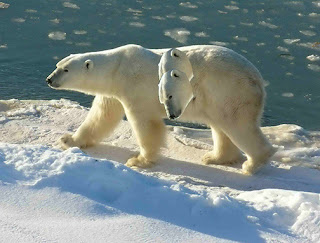 This polar bear's neck is about 3/4 a head in thickness.
 When you're talking about fur thickness and exterior information, you can use your own judgement on what you think looks best - that becomes the "art" part. But know what the proportions (at least the measurable stuff underneath) are first before jumping into the fluffiness. Draw from the inside, out. go and draw awesome animals. have fun drawing!
Thanks for stopping by.

Proportions of animals are a little harder to figure out because the landmarks on humans are different than on animals. I mean, we stand on two feet, they walk on all fours etc. but one thing that is consistent with animals in general is the skeleton. With that said, if you are studying any kind of animal - human or otherwise- you need to know what's going on underneath, in both bones and muscles. If you don't how to get started doing this or if you have used the internet to look up an animal (say a squirrel monkey) and can't find any on the animal's anatomy, use it's Latin name (Simia sciureus) and you will be more likely to find information more closely related to the animal's anatomy.
But, and this is important, CROSS REFERENCE your information! I have seen students bring in anatomy reference examples, drawn by other previous students, which are downright wrong. Photos are best but scientific illustrations are good as well if care was taken to scan or photograph them. If you can't find anything about your animal, look up which zoos have your animal in their collection and call or email them or their veterinarian and ask about reference material for the animal in question. Or talk to a zoo keeper, they are pretty cool and can help you in your endeavor. and they are happy to help if they can. There is always the tried and true method of GOING TO YOUR LOCAL LIBRARY to do some research (gasp). I know a lot of librarians-they are really cool and willing to help! And lots of libraries have free WiFi...and some even have coffee shops...what more do you need?
When you finally do acquire reference of the animal's anatomy, namely in profile, measure the skull from the front/tip muzzle to the back of the head where the spine meets it. Most quadrupeds have a spine that meets the skull at the back rather than below, unlike humans. Below is a photo of a polar bear, ursas maritimus, acquired from this site. Even this specimen, as beautifully as it's been articulated, isn't exactly correct as the fore paws are too far forward for it to stand naturally, but let's move on. I, like many others, LOVE polar bears; they are so large and furry and cool and furry and chunky and furry and furry. Did I mention furry? When you are just getting started drawing them, all that fur kinda gets in the way and you end up with weird bear shaped balloons because...furry. The skeleton has no fur so you can measure without distraction, woo! 'Had a student once who said, "I can't draw this cat because it's fluffy." Ahem, skeleton, duh.


Okay, okay...you're right. Not everything can be measured by the skeleton. You can also measure with a fully furred animal. Here's a photo from this site. Aw, a big furry polar bear, awwww!


Thanks for stopping by.
Friday, August 8, 2014
Animal Drawing: Gorilla
Skeleton, keep it simple. The shape of the ribcage is of more interest (at this point) than drawing each actual rib. It's a huge barrel, just be sure to follow the form of it. Study the skeleton of your animal, measure the skull and compare it it to the lengths of the other bones in the body. This will help you make more accurate drawings. Students of animal drawing tend to draw the gorilla's arms a little short at first.
 (The cervical vertebrae are much longer than a human's for more surface area for the muscles of the neck to attach. Scapula come forward more than humans, cross your arms in front of you - that's how gorillas' scapula sit naturally as shown below.

Gorilla surface anatomy is very similar to human anatomy.

 See?
See?

To keep you going, I have added some gorilla models sheets from Walt Disney's Tarzan (1999) (Hehe:)


 Or if Tarzan isn't your style, here's a fun one from "Superman; Terror on the Midway" (1943 Fleischer)

The muscles labeled below.
...And all of that stuff underneath fur
To keep you going, I have added some gorilla models sheets from Walt Disney's Tarzan (1999) (Hehe:)
Sunday, March 3, 2013
Anatomy: Find the parts you know...

Recently, a student sent me this image of a common European mole skull (Talpa Europaea) asking how to find the eye socket on this little creature. At first glance, it is indeed difficult to find because the eye is not where you expect it to be. This mole, like most, spends nearly all of its time underground digging its way toward even smaller critters to eat. It's need for sight is almost unnecessary and the eyes have become nearly vestigial as the skull, over time, has evolved to enhance other, more necessary features; smell and strong, crushing jaws, not to mention, very large forepaws for digging (not shown).

Luckily, this animal is a mammal and with a little thought; you can locate landmarks in the bone structure that are comparable to anatomy we know well. I have pointed out recognizable bone masses below. The Zygomatic region (Zygomatic Process, Zygomatic Bone, and Zygomatic Arch all surround the Orbital (Eye) Socket and that tiny triangular shape is the home of the animal's eye.

Knowing this, we can now add the features. This mole has a relatively large nasal opening, making its nose a big shape as it angles up off the snout. Its large flat Mandible allows for a thick masseter (jaw muscle) and the sloping arch of the epicranius allows for a very strong temporalis. I have sketched in the head of this animal of the skull and below you can see the sketch more clearly.


Subscribe to:
Comments (Atom)