

Wednesday, August 7, 2013
Sketchbook 2013 students.
I am a little sad the Sketchbook class has come to an end as the semester is now over. What a great bunch of students. Good luck to you.


Tuesday, July 9, 2013
Costume: Armor!
Just a note to say; the included image should be considered an example of...

Nice pauldrons, though. Really, it's -in a word- IMPRACTICAL. I know I am alienating all of you gamer folks who follow this blog (probably not...because gamers don't follow it), but a boob window?? And a cape? Or should I even mention the obvious? She would do better with some serious beach time or a new addition to Jabba's palace. I know, I know, "But she has a sabatons" Okay, you win. Because that would totally deflect any arrows or pikes or katanas or yaris or cannon balls. Armor is about protection. No, not that kind of protection, protection from sharp pointy things, or blunt things or fiery things or any dangerous things. Going into to battle dressed this way, may get the enemy's attention, but this young lady certainly won't last long no matter how good a warrior she is. Besides, it's the freakin' ENEMY, who wants to KILL you - and rape your freshly dead body, so who gives a crap how sexy you look fighting him/her/them? War ain't pretty and arming yourself like this is just stupid! Try this: tear off all of your clothes (right now) run head long into a cactus patch, a series a plate glass windows, a metal foundry or just fry up some bacon. I will wait....back? Okay let's talk armor!

In review, the above is not armor but we should start here. Feminists, don't turn away in spite (yet) the above drawing will be used to get across my above point. This young lady is vulnerable due to the fact that she is only 'armed' in a one piece and she hasn't a of drop of sunscreen on.
 Here, she is stepping back in time to days of the Hoplites, strong Greek soldiers, who wore the linothorax as armor. Note the bare arms, thighs and sandals. No matter how strong a force they were, I can't help but to curl my toes at the thought of wearing sandals into battle...I mean, there was a lot of sharp stuff that was sharp sharp stuff hurts exposed toes and... and SANDALS?! Yeesh, no wonder those dorus were so long.
 A little later into the 13th century (all you guys who know all about this stuff, feel free to correct my time placements and naming conventions for the sake of making stuff correct for these poor folks who follow this blog. At least we have covered her feet with boots and now instead of strips of cloth basically glued (with animal fat or other stuff) together (ptergus) with a layer of bronze scales around the chest in Greek armor. Knees and hands are still in danger and the head, though protected, will suffer the impact of a major sword or mace strike.
 So we move on to the 15th/16th century when soldiers of all sorts resorted to better armor made of metal plate. A knight or warrior would start with the above to make comfortable the plate and also to absorb the impact of weaponry which may glance off the armor but the blow would still be quite deadly without the soft multilayer cloth underneath. Chain maille would be laced to the doublet to protect those spots not covered by the plate armor.
 Large pieces of plate would then be tied to the doublet with cords called points to secure it. Shown above the chest piece, the tassets to protect the hips and loins, which were attached to the fauld, the lower out-turned portion attached to the bottom of the chest piece. Upper and lower arm pieces connected by the couter or elbow piece.
 Legs would be protected (at least on the anterior side) by the tying or belting on of leg pieces-a lot of armor protected the front of a fighter but not the back. Because the fighter may be riding into battle on a horse so not needing the weight of the armor covering the back. Thighs were protected by the cuisse, lower leg protected by the greaves which sit over the sabaton (the vented "shoe" which covers the top of the foot. The knees are made safe by the poleyn which connects the cuisse and greave.
 Finally, the helmet is added (the pauldron at this time were actually attached to the chest plate, I added them here to show the chest armor better. Look at the above. Very hard to tell this warrior is a woman (though they did exist; legend has it that a custom suit of armor was commissioned for Joan of Ark by the King) and not very likely to sell games geared toward adolescent males hungry for bloodsport and female bodies. But the reality is, battle is dangerous and anyone engaging in it would have taken precautions. Warriors, being less concerned with attractiveness on the battlefield, would do what they could to cover themselves completely rather than suffer the slings and arrows of outrageous fortune. A real battle would be short lived if fought in a bikini.
 Now, on the other hand, if you want to make your young lady attractive and still seem 'bad ass', dress her in a bliaut. Mmm....bliaut. Ladies do a lot for this piece of (generally French) costume. Ceremonial sword (note severe lack of weight in how she wields it.


 Back to armor. Using the information including the terms mentioned above, you can start to see how even made up armor is based off what has come before. The above stormtrooper is labeled with the correct components (even if those components are referred to as something else in stormtrooper land). I know quite a few people who still call pieces of this armor "leg thingies" and "shoulder do-dads". This will make you seem much more intelligent if you refer to these pieces by their proper names. Notice that in putting on the white plastic armor, the wearer usually will need a black body suit, gloves with a bit of the armor on teh back of the hand taken from half gauntlets called demigauntlets. The head can also be covered with a racing or cranial sock but look at the presence of the gorget. The next step allows for the leg pieces and arm pieces and a large piece at the middle that covers the lower abdomen which in armor terms is called the plackart. This piece was designed to sit around the lower abdomen under or near the chest plate, sometime attached to chain maille or leather studded chest armor. In this case, according to my geek and some research, the plackart and cod piece is all one piece and the utility belt is simply strapped over the plackart. Were this actual armor from certain periods, the cod piece and plackart would be separate pieces to allow for a greater range of motion. The helmet follows as do the spaulders if you are regular Imperial forces. Sand troopers have an additional spaulder attached to a mantle as well as extra ammunition pockets. They also get to wear a backpack and larger range weapons. Now have a look, the sex of the wearer is completely obscured by the armor in any case. What makes the armor 'sexy' is how it's worn in battle and the fighting capabilities of the wearer.
I admit, I have always loved storm trooper even though it is (apparently) completely useless as it can't even deflect a single blaster bolt and seems to impair the vision of the user so much that it's difficult to hit an enemy across a hallway (Despite all that, I would TOTALLY have one myself if I didn't have other stuff like kids, or a mortgage to spend my money on.)
 So here's a little test. Look at the fictitious armor above and label the parts without refer to the above images. Or, even better, go see Pacific Rim and yell out the components of the armor you see on screen, you will be surprised how much you've learned and the people around will really appreciate you help. More later, thank for stopping by.
Special thanks to the great Craig Shira for bringing his collection of armor and weapons to wear, show off and discuss with my students and to my colleague, friend and fellow dad; Owen "Shut up, I'm a VIKING"Aurelio for his knowledge on this subject. Also I recommend this great book.
Go draw armor! Be sure to make ping, clang and explosion noises while drawing because they make drawing this stuff cooler. Thanks for stopping by.

In review, the above is not armor but we should start here. Feminists, don't turn away in spite (yet) the above drawing will be used to get across my above point. This young lady is vulnerable due to the fact that she is only 'armed' in a one piece and she hasn't a of drop of sunscreen on.


I admit, I have always loved storm trooper even though it is (apparently) completely useless as it can't even deflect a single blaster bolt and seems to impair the vision of the user so much that it's difficult to hit an enemy across a hallway (Despite all that, I would TOTALLY have one myself if I didn't have other stuff like kids, or a mortgage to spend my money on.)

Special thanks to the great Craig Shira for bringing his collection of armor and weapons to wear, show off and discuss with my students and to my colleague, friend and fellow dad; Owen "Shut up, I'm a VIKING"Aurelio for his knowledge on this subject. Also I recommend this great book.
Go draw armor! Be sure to make ping, clang and explosion noises while drawing because they make drawing this stuff cooler. Thanks for stopping by.
Monday, July 8, 2013
Costume: Types of Folds
There are two major categories that folds fall into; Hanging and Supported.
Hanging folds are folds from unsupported material. They collect/hang in a natural pattern and if there is only one origin, the material will hang in a series of triangles or tubes called 'pipe folds' as shown below.


In the simplified drawing below, pipe folds cascade down the under layer of of a toga. A diaper fold is also shown across the breasts and pull folds are seen at the shoulder joints. Pull folds will be discussed later.

The complete toga is a series of pipe folds but as the material is wrapped around the figure, pull folds begin to happen.

When the material is not just hanging but sewed together so it 'fits' the figure, the folds are called supported. Supported folds include; Pull or tension folds, compression folds, and spiral folds.
In this example of a 1950's Cheerleader uniform, the pleated skirt creates a series of pipe folds. Because the blouse is tucked in to the wrapped portion (spiral folds) of the skirt, we see many compression folds and also in the cuffs.

Spiral folds generally happen with lighter cloth and the material makes circular patterns around the arms and legs when the sleeves or leggings or tighter on the appendages. Wear a long sleeve shirt and push the cuff up forearm and you will see spiral folds.

Pull or tension folds are made when the figure twists or moves in a way counter to the origin. Below, the shirt is tucked into the blue jeans. The model's twisting motion is causing pull folds to move up from the waistline to the chest. Also pull folds are happening through the crotch line in the jeans. Compression folds are happening at teh knees and ankles as the heavy jean material "piles" at these points.

Friday, May 31, 2013
Composition: Good Tangents (and other stuff) Part 2; The Shining
This the second of two parts with regards to good tangents, see part 1.
In 1980, my dad took on the task of painting the entire exterior of our house and to do so, he covered up all of the windows with newspaper from the outside. The only problem from my eyes (I think the color was wrong or something so it took longer than my dad expected) was an add for The Shining was on the page that my dad chose to cover up my window. So, for a little while, whenever I walked into my room I was greeted with this newspaper add and it give me the chills whenever I saw it. Finally I had to keep the curtains closed every hour of the day lest I get too creeped out to play with my Star Wars stuff and have to retreat to some other part of the house. I never told anyone about that because , well you know. Just keep that little part between you and me. Anyway, because of that experience and because of TV adds like this (except not in Britian) I was too scared to see The Shining. For a really long time. Not being one to watch scary movies, I just steered clear of this genre especially this movie. Finally when I was in college, Bonnie, the girl I was dating at the time, was astonished to discover this and convinced me to watch this film. Yes, it did scare the hell out of me (another thing we can keep between us, hmm?) but it also captured my attention. This movie creeps me out with each viewing but I still love it, even if I am left looking over my shoulder when I walk down long hallways
I love what Stanley Kubrick and cinematographer, John Alcott, and editor, Ray Lovejoy and the crew did to make this such a powerful film.


 Take a closer look at this composition. Those knives behind Danny. The knives behind Danny! They are all turned so the dangerous edges are facing Danny, looming over his head, like the teeth of a T-rex ready to chomp down. Take this into account also, (Spoiler #4) the staging of the two characters places Hallorann's back to the ice box, THE ICE BOX, and Danny's back toward the exit...coincidence? I think not!
 When you think of two little girls holding hands, you think of a sunny park setting where two happy children enjoy each other's company, right?
 Wrong! As Danny sits in the staff lounge shortly before the ice cream segment, he turns to see two girls holding hands, who slowly, wordlessly turn and walk through the doorway. But why does it seem so startling? It's just little two girls...who turn slowly, wordlessly, staring straight ahead and quietly walk out through the doorway. So beyond acting, why?
 Here it is, tangents! That's right, I know it took me a while to get to the subject (true to form, right students?) but look at the trim that goes around the walls. The girls eyes are exactly tangent to it, and the way the longer lens (telephoto) camera is angled on the two walls in the shot, the whole room feels compressed which is exactly how it is intended to feel. As mentioned before, tangents flatten space and Kubrick/Alcott use this to their advantage. They force the girls to be part of the walls, part of the hotel itself.
 To further this, the girls are vertically tangent to their surroundings; shoulders buttressed against the door frame and the cushions, their heads are visually connected at the corners of the poster behind them (thus the reason for the slow turn), dress hems tangent to bottom of the door and the cart where the cushions lay. The furniture is not tangent or parallel to the walls which one would expect, but are turned uncomfortably to act as points or feel like teeth. If Danny is not careful he will bump his elbow or poke out his eye when he leaves this room.
 The only real round thing in this shot is the red alarm bell...and later when you see one of those, danger is around the next corner (Spoiler #5). The girls do talk later...see me starting to look over my shoulder? Let's move on.
 Aw, isn't that nice? The idea of a little boy walking in to visit his dad who's not feeling well. Nothing at all wrong with this scene, right?
 Wrong! What if the little boy is surrounded by his dad? Surrounded by his dad? You heard me! You'll see in a moment why little Danny is surrounded.
 And in surrounding Danny, the two off kilter dads form a weird triangular staging pattern that forces Danny low and give power to Jack(s). This is a pretty uncomfortable scene. Danny wanders in the bedroom to get his fire truck and look in on his father mean while, all the audience can do is say, "get outa there, Danny, get outa thereeeee. Don't go in there..." Spoiler #6.
 Here is the shot. Danny has entered through the light colored doors, "Come here." says Jack and Danny does. We know Jack is losing it, but Danny is still his son and loves him. What about this scene makes us so uncomfortable? Definately the two Jacks, the real one facing away from the camera and the reflection facing toward us but eyes on Danny. How did they get this shot? They moved the dresser out into the archway. Out of context, one would have to ask, "Who the heck leaves a dresser in the middle of an archway?" The curtain behind the dresser hides the placement, slightly, but we don't really notice this because we are to busy saying, "get outa there, Danny, get outa thereeeee. Don't go in there..." Danny is surrounded by the cagelike/netlike doors which places him in a creepy nest of tangents.
 But that is just a small part of it. Both the reflection and Jack are linked through the tangents of the archway. Creating a disturbing frame through which Danny has to walk.
 On top of this, notice Jack's reflection, the bed head board makes a tangent that passes right through Jack's eyes while the real Jack sinks into the background through the tangents of the painting and the lamp shade by his shoulders. There in the picture is a woman (a naked woman -Spoiler #7) who almost stands on Jack's shoulder appearing to give Jack instructions. Jack is, without a doubt, falling in to the grip of the Overlook. And you can't help to feel that Danny is next.
 The shot changes as Danny nears Jack and gives him a hug. "I love you, Danny. I love you more than anything else in the world" Jack says...
 Random shot of Danny on his Big Wheel, tearing through the halls of the overlook. The placement of the camera lower than Danny's eye line, the speed of the dolly to follow, even the sound of Danny riding this toy is unnerving. With each turn, we have no idea what will happen next. Most of the time nothing does which puts us ill at ease, but in the above image...oh crap, is that one of those red alarm bells? Spoiler #8.
 This shot is nuts. To set up a POV of Danny, the camera operator had to lay on the floor, shoot through Dannys arm and handlebars, up on Danny and on to door 237. Though there are tangents here, they don't yet mean the same thing as Jack's tangents. There is a long pause here with the expectation that something terrible is going to happen, then Danny gets off the Big Wheel...Spoiler #9.
 Lloyd. Lloyd the bartender. Lloyd the bartender who shouldn't be there...who ISN'T there. But bartenders are okay right? This bartender is okay, right? WRONG! Meet Lloyd...who will be playing the turning point of evil tonight. Lloyd the enabler. Lloyd who gives Jack exactly what Jack wants but is last thing that Jack needs. Spoiler #10!
 Lloyd with the tangent through his head, twice! His eyes are at the shelf level where the alcohol rests. Lloyd, the guiding spirit of the Overlook. "Women. Can't live with them, can't live without them." quips Lloyd. Why do I keep looking over my shoulder?
 Poor Wendy and her tangents. When Wendy is tangent to the background it suggests something, which I'll cover in a moment.
 A little time has gone by, Jack has completely lost it, Wendy has knocked him unconscious and locked him in the pantry. Take a moment to see and understand this composition. Jack is standing by the door demanding to let out. He is facing the floor and the camera, which means the camera operator is lying on his back shooting an up shot at Jack. Why? Because it weird. And it is a throw back to the shot of Wendy above. Look at the space surrounding Wendy in this centered up shot, there is more space on the sides, but her turtle neck is tangent to the paper and the varied values behind her. This is one point perspective, centered shot consistent in style with Kubrick who really liked shots that exhibited one focus. Here this flat, single vanishing point approach focuses the viewer on Wendy's discovery at the type writer and the timing is perfect. She reacts to the pages but we can't see them, leaving the audience to crave to know what is on those pages. Then, we are given a POV reveal of the pages and the audience says, "Uh, nevermind I didn't want to know." (Looks over shoulder) Spoiler #11.
Back to Jack in the pantry above. He threatens Wendy on the other side of the door and provides another reveal. "You've got a big surprise coming to you. You're not going anywhere. Go check out the Snowcat and the radio and see what I mean." And when Grady's voice arrives to let Jack out we see Jack talk down to the floor (us), to hell (we are in hell) and Jack intends to take Wendy and Danny there too. Spoiler #12.
 The bathroom scene. What about the tangents here? Crazy jack is pounding away on the bathroom door with the axe as Wendy cowers in the bathroom. This is visually striking because, with each blow, the axe comes nearer and nearer to Wendy. Finally the axe breaks through completely Slicing the plane of the door, the last tangent, and through overlap visually pierces Wendy's space. Implied death. The only thing that saves her is a knock at the front door of the hotel...Spoiler #13.
 Wendy, temporarily safe, tries to escape the Overlook and find Danny. The haunted hotel is now throwing everything in it's power to keep Wendy there. The lighting changes, gels are on the lights, in this case, purple to yellow contrasts. Weird, scary stuff is happening everywhere in front of Wendy and as she mounts this staircase she pauses, suggesting that she sees something.
 What's going on here? Look at that phone cord running down the wall, the shadow of the banister, and Wendy's turtleneck. Poor Wendy. Implied death (happens more than three times to Wendy). She is becoming part of the Overlook whether she likes it or not.
 This shot is about lack of tangents. I just love this shot. It is so subtle but is still a beautiful composition. Amidst the chaos of the interior, this cool and empty, perfectly balanced composition offers relief. Danny has gotten away from the Overlook, just one more "hurdle". Not really a spoiler.
 Just to see how balanced this composition is, I removed the light post. Notice how the image seems heavy, weighted to the right side? It just falls apart because the large dark shapes overpower the rest of the space. The thing that holds it all together is that tiny speck of highlight at left. Though this last image isn't about tangents, it, like the rest of this post, is about well thought out composition(s). Before you leap into drawing your shot or setting up your camera, take time to plan. Is your shot/image well composed to get across a sense of hierarchy? Is it easy to read? Are there tangents in the shot? Do they work to push the story or do they accidentally flatten your composition? Plan your shots. Go make awesome. Thanks for stopping by and don't hang scary movie adds on your kid's window by accident.
In 1980, my dad took on the task of painting the entire exterior of our house and to do so, he covered up all of the windows with newspaper from the outside. The only problem from my eyes (I think the color was wrong or something so it took longer than my dad expected) was an add for The Shining was on the page that my dad chose to cover up my window. So, for a little while, whenever I walked into my room I was greeted with this newspaper add and it give me the chills whenever I saw it. Finally I had to keep the curtains closed every hour of the day lest I get too creeped out to play with my Star Wars stuff and have to retreat to some other part of the house. I never told anyone about that because , well you know. Just keep that little part between you and me. Anyway, because of that experience and because of TV adds like this (except not in Britian) I was too scared to see The Shining. For a really long time. Not being one to watch scary movies, I just steered clear of this genre especially this movie. Finally when I was in college, Bonnie, the girl I was dating at the time, was astonished to discover this and convinced me to watch this film. Yes, it did scare the hell out of me (another thing we can keep between us, hmm?) but it also captured my attention. This movie creeps me out with each viewing but I still love it, even if I am left looking over my shoulder when I walk down long hallways
I love what Stanley Kubrick and cinematographer, John Alcott, and editor, Ray Lovejoy and the crew did to make this such a powerful film.

Even the opening title sequence is long and slow with droning, creepy score by Wendy Carlos and Rachel Elkind. Why did they do this? To show just how far away the Overlook Hotel was from the rest of the civilized world. If anybody was all the way up there in that hotel when it was closed for the dead of winter, buried in snow, and somebody did get a dose of cabin fever, it would be curtains (or elevators full of blood) for everybody with no hope of being saved even if you could 'shine'. (Spoiler #1)
BTW, hardcore Stephen King fans, I know this is step away from the book and you all are still feel angry so you can skip this post and go back to your TV mini series of the same title (which uh, did not meet expectations excepting the topiary scene).
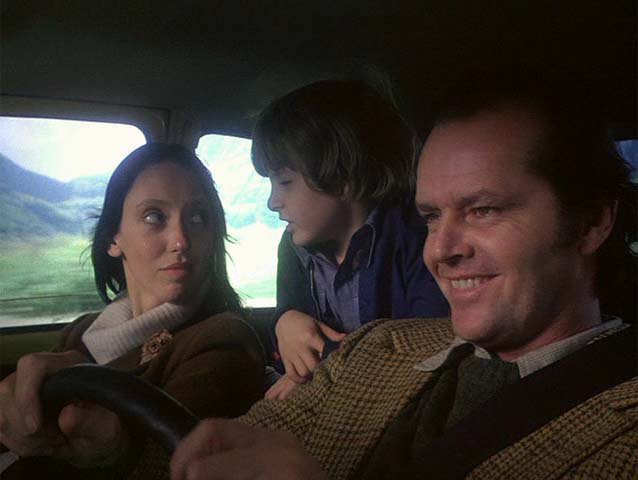
Finally after the interview with the Overlook manager, Jack takes his family on the long drive to the Overlook. Because the original intended aspect ratio is 1:1.33 even the car ride feels cramped (not quite trapped yet-spoiler #2). Note that even in this happy family sequence Jack is generally shown in the shadows of the car's roof, Danny faces Mom (Wendy) who is in the light and Wendy is looking back at Danny away from the light. ...Dark...(Spoiler #3).


At the Overlook, Danny meets Dick Hallorann, the head chef. The two have a "private" chat about Shining and eat ice cream, innocuous right? Wrong! The way this shot is composed, with the camera low on the table angled up at the Danny and Hallorann, but still distant from the two makes them appear small in the shot and gives an ominousness to the kitchen. It almost feels like someone or something is listening to their conversation through the gaping hole that is the chef office's windows.


Back to Jack in the pantry above. He threatens Wendy on the other side of the door and provides another reveal. "You've got a big surprise coming to you. You're not going anywhere. Go check out the Snowcat and the radio and see what I mean." And when Grady's voice arrives to let Jack out we see Jack talk down to the floor (us), to hell (we are in hell) and Jack intends to take Wendy and Danny there too. Spoiler #12.


Thursday, May 30, 2013
Composition: Good Tangents Part 1; The Matrix
Back in March of 2012 I posted about tangents. Most of the time in my classes, students are so busy creating an image that they tend to loose track of lines and the resulting tangents flatten the intended space and makes the image confusing. As we continue to cover composition, I am posting screen grabs from two great films that use tangents to their advantage. This post focuses on the 1999 blockbuster, The Matrix. Huge props go out to the directors, The Wachowski Brothers, Director of Photography, Bill Pope, Editor, Zach Staenberg and the crew who put this together. My favorite sequence isn't one of the action sequences or 'super hero' nature of the "bullet time" effects but the interrogation scene involving Agent Smith and Morpheus. Hugo Weaving's performance is fantastic here and everything comes together quite well in this moment and the tangents in it act as divisions between the characters. You will find these 'divisions' throughout from start to finish especially in sequences that describe Neo's education in the world of the Matrix. The "Morpheus is fighting Neo" (better known as the "I know Kung Fu") scene is full of these divisions and is a lot of fun to watch from a cinematographic stand point, but the interrogation of Morpheus is the best part IMO.
 The Scene starts will the pulling of a metal chair. (Everything in the Matrix is harsh and non-organic, especially interrogation chairs.) Camera tracks and dollys with the chair to cut on Morpheus. Note the seam in the paneled wall behind Morpheus, it sits forcibly between Morpheus and Smith.
 Smith sits casually, quite comfy in the metal chair, very much in control. But Morpheus is shot at exactly the camera length and height as Smith. They have equal weight at this point and this it's an even battle of wills. We do cut away at this point , but luckily we come back quickly.
 The Virus dialogue. Despite it all, one could say Smith is pretty correct in his observations about humans and viruses. The two still have equal weight. Smith leans in on Morpheus and almost breaks that division.
 The lean in allows for a new shot setup; a close up with a slight low angle on Smith followed by nearly the same setup on Morpheus. Cut away again.
 Cut back to "The Serum isn't working" "Maybe we are asking the wrong questions." Leading Smith to get up and move across the room to a new division. "Leave me with him...Now" Smith has been allowed to establish a new position in space, he is on the opposite side of Morpheus and new divisions can be seen.
 Cut to Morpheus in frontal,slightly lower than his eye line to show his strength and also to visually complete the cross of space. large black frames in the window as well as the rhythms of the building in the background act as bars in Morpheus' 'cage'.
 Morpheus is in a dark place, camera is higher on him now, he is slowly loosing the fight, still divided by the background from Smith. Cut to Smith (in the light though hinting at the darkness) who pulls off his glasses and the ear piece. He is going to bare all in an attempt to win the struggle.
 Camera still slightly higher off Morpheus' eye line as we OTS off the very close Smith. Cut to Smith, the camera is lower than his eye line, giving him a little more power, he is pushing in on the division. Building on the tension, that dark line is an implied, weak force field separating Smith from what he wants.
 Smith gets closer, still, to the tangent division. Another thing that is happening here is Smith's dialogue; the only one who is telling truth or giving anything away is Smith at this point. "I hate this place, this prison" High on Morpheus OTS Smith now very close, tension mounts.
 Morpheus is about to loose this battle of the minds, he is very low in the shot as Smith looms over him. Smith's finger enters shot and "breaks" the line as the Matrix "twinkle"sound is heard, Smith's hand passes or CROSSES the line, the last barrier to get inside Morpheus' head.
 OTS off Smith on Morpheus, Smith's hand on Morpheus' head, his shoulder trapping Morpheus, almost cradling Morpheus head. Cut to Smith, crossing the division almost completely.
 He takes Morpheus' head, as Morpheus' struggles, division-less.
 Finally Smith in Extreme Close Up, OTS off of Morpheus. His head overlaps Smith, their foreheads visually touching, begin the 'mind meld'...only to be interrupted by the other Agents...and a helicopter...
Stay tuned for the second look at 'good' tangents, coming soon. Thanks for stopping by.


Stay tuned for the second look at 'good' tangents, coming soon. Thanks for stopping by.
Subscribe to:
Comments (Atom)