Good morning. While thinking about composition it's a great idea to employ the use of the "Rule of thirds" as a basic visual balancing tool. I am just going to assume you know what that rule is about because you can do a search and just about every site that mentions it gives you an idea what it is. Go ahead and do a quick search on "rule of thirds" or even "composition principles"...I'll wait....
Okay so hopefully you were lead to a good site which imbues valuable information about the above topic. Did you notice that in all of the information there are suggestions of what to do with your nine equal segments and four main intersections, but you'll be hard pressed to find a site that tells you how to actually divide your frame to allow for the rule? Now I now that there are those sites that lay down the complex math that the Greeks came up with long ago, and if you're into that-more power to you. And I also know that the human eye can see in thirds nearly as easily as seeing in halves or quarters, but it takes practice. If I asked you all to simply draw a frame and then eyeball divisions of thirds, you may make a good guess but how do you know your guess is exact?
Well friends, here is a quick method to construct intersections to help you with following the rule.
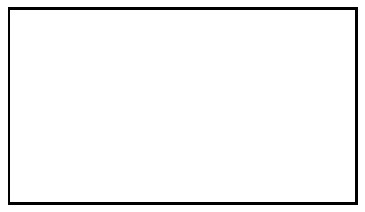
First, you have to start with a frame. This method will work for ANY rectangle or shapes with four corners (it also works with shapes with more than four but I'm trying to keep this easy). above, you have the basic 1.77:1 aspect ratio most of you'll know it as 16x9. If you need me to explain the proportions of the frame, leave me a comment.
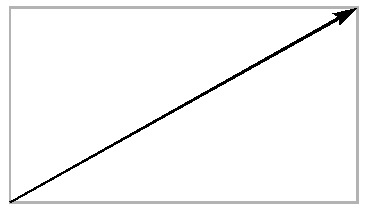
Next draw a line from opposing corners, bottom to far top corner, etc as shown above.
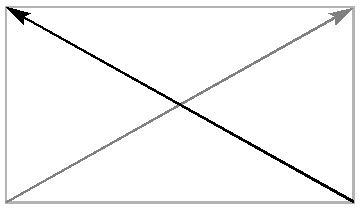
Repeat this with other opposing corners.
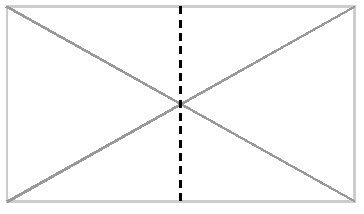
The "x" you get will denote the center of the rectangle. High school geometry is suddenly coming back, huh? Draw a line parallel to any side so that it passes through the "x".
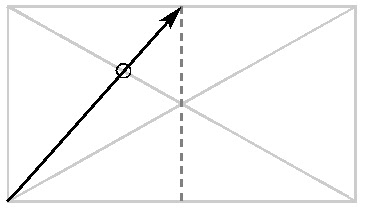
Now draw a line from an opposite corner to the medial intersection - the middle top. Where the original diagonal and the new diagonal intersect is a THIRD! Really. Neat huh.
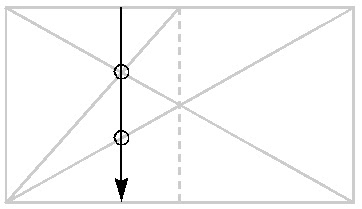
Now the rest is easy but I'll just show you in case. Drop a line parallel to the short sides down and where it intersects the diagonal is another third as shown above.
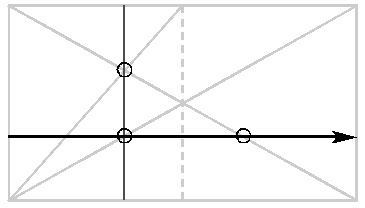
A parallel line with the long sides (top or bottom) will give you the next third at the intersection of the diagonal.
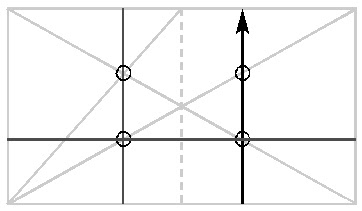
Almost done now, draw a line parallel to the short side again, this time so it passes through the intersection of the new third aaaaand WHAPPO! you've got your four main intersections.
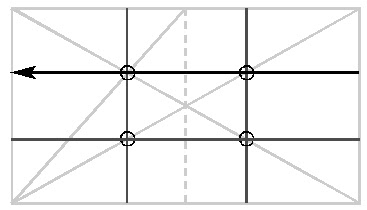
Now just draw lines that are parallel to the sides through the intersection and you've got your nine equal unit divisions.
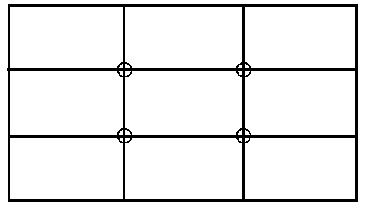
Leaving you ready to work in the thirds for your composition. Take time to memorize this process, seriously draw frames this way at least one hundred times with the thumbnails you do and you'll get so used to seeing the intersections, you won't have to draw the lines that make up this method.
Next up, some composition tips


 I know the Batman's cape looks weird, oh well, she was happy with them.


 Probably posted these Santa's already (too lazy to check)


 ...If you want to see the ruffs for these let me know.


 Leaving you ready to work in the thirds for your composition. Take time to memorize this process, seriously draw frames this way at least one hundred times with the thumbnails you do and you'll get so used to seeing the intersections, you won't have to draw the lines that make up this method.


